What do chefs look like? What do they do?
Today in Sur La Table I presented my fancy dish towels and OXO cherry pitter to the cashier and asked for the professional discount.
Yes, certainly, he replied, asking for my name and punching away loudly at the computer. Then he asked me if I could verify where I was working, because they had me in the computer but not as professional level.
Hmmm, I said. I had business cards in my wallet with proof of Boston-area pastry professionalism, but nothing out here.
I work in the Ferry Building and they know me so they just give me the discount I said. I didn't add that I'm usually wearing whites at the time, so (clearly) a chef. I flashed him my business card and he upgraded me in the computer.
Then I went across the street to
Stonehouse to get some fancy olive oil and balsamic vinegar for my mother's birthday, because their dark balsamic is so good it's going to make me have to stop pretending I don't like balsamic vinegars (well okay I like them reduced down, with cream, such a baker, sheesh). And the cute fag behind the counter tells me he thought I was here for the bike shop and not the Stonehouse products. I tell him about Sur La Table.
While at
Ici having lovely ice cream--chicory chocolate chip and gingersnap which was lemony and bright if a touch too grainy on the mouth--I thought about my day. (And it's a good thing I'm moving to SF soon or I'd go to Ici every day. I LOVED it.)
When I was a kid I fell in love with a profession with no money, vague hints of success, and no clear career path. I was going to be a writer! It was marginally better than what I'd hit on before, an actress. As I finished high school and put myself through the best college I could get into, I still thought I'd be a writer. I thought it would happen if I read the right books, if I made friends and mentors of my teachers. One day it's just happen and then there I'd be, a writer. If I worked on lit mags, if I tried to get published, if I stayed up till three a.m. writing a story. All of these more benchmarks on the way to writer-dom. But if I went ahead and got my MFA, then I'd be one leap closer to the real thing. If I got a job as an editorial assistant and lived in Brooklyn or Queens, commuted to Simon and Schuster or Scholastic or Penguin Putnam or, my favorite, Vintage Contemporaries (division of Random House), I'd also be on my way. I collected books and authors, kept (and still keep) annual reading lists. I read the writing guides. I sought out queer writers and invited
one of them to read at
my college. Then I got out of college. I lived in New York. I worked a desk job, 9-5 and struggled severely with all of those questions you have when you're 22. I wanted all these things in life, but how was I supposed to get them doing this? Here? No one I knew in New York was really happy...or doing anything we wanted to be doing...we were all just sort of hanging on and trying to get ahead.
I was accepted into the MFA program at Emerson College and moved back to Boston.
I learned a few things at Emerson, but one of the main ideals that became my practice during my time there was this: claim yourself. Claim yourself as a writer because the world isn't going to do you any favors. All hundred-plus of us at Emerson were geeks, nerds, budding poets or screenplay writers, essayists or novelists. Most of us worked full or part time. Most of us were female, and white, and though this has changed since I began, only a handful of us were queer. It was challenging enough to write stories with a different voice and from a different place than my peers, but while living out the MFA dream I realized it wasn't going to get me where I wanted to go. It might land me an editorial assistant gig, if I took some publishing classes. It would let me teach as soon as I published something hot and earned a reputation. But the MFA wouldn't make me a writer. It gave me time, and a room full of peers. But I was still going to have to make my way as a writer alone.
Halfway through my MFA I decided to go to culinary school, because I was getting old enough to realize I wanted a real, steady career and I didn't want to graduate and sit behind another desk. A couple weeks later there I was, in my first professional kitchen. In school, the pastry girls didn't really understand what I was doing, dashing from cooking class in Cambridge across the river to writing class in Boston. At Sonsie, during my last semester of grad school, no one got it either.
I handed in my thesis, I'd say.
I'm finished. I have my masters. I'd only get stares. They didn't have to ask me why I was getting my masters if I was a pastry cook...or why I was being a pastry cook if what I wanted was to write books. The duality was outside their comprehension or realm interest. In every kitchen I entered, I had to make the same claim: I'm a writer. And, yes, a baker. A chef.
Claim yourself. No one else is going to do it for you.
The expectations are similar for chefs. What does a chef look like? Not like this.

What does a chef do? What does a chef wear? Are bakers really chefs anyway? I call myself a baker and I don't think it's a pejorative word. But some people do. At work sometimes I fall into the trap of thinking that my experience is more valid or more strong than other people's experience because
I've worked in restaurants. This is egotistical whether or not it's true. My industry is pretty hot right now, and the restaurant scene is the scene. Those of us who work at tiny, independent bakeries, or for caterers, or for bread-makers, or for farmers, or for ourselves...well, we're somehow less than. Other than.
We are taught that restaurants are sexy, if a little scary. Chefs are (usually)Male. Older. White. Straight. Cooks are younger version of Chefs. There is a mystique and culture to being a chef that gets represented to the general public by Anthony Bourdain, Jamie Oliver, Tom Colicchio. Being queer in the kitchen is hard and it's something I haven't always been forthright about. Being a women in the kitchen, also tough sometimes. Being in the kitchen and having claim to a life outside the kitchen--being a writer in the kitchen--well, it makes you a little untrustworthy. A little suspect.
I'm outside the culture, but where am I? Do I call myself a baker, and with pride? I don't call myself a pastry chef, not comfortably. That would imply some amount of knowledge, skill, status, power, and income I just do not have right now. The girls at Frog Hollow want to call me "pastry chef extraordinaire." Especially when I purposefully drop things so they can try them. But I don't want that title. I'm not just a baker, not just a cook, although I do those things. I'm the girl running around with cherry juice stains on her hand, the girl the guys at the Berkeley farm market ask about the burns on her arms. I'm a writer, and a cook, but what to call myself, how to claim it? Short of wearing whites at all times, I can't dress the part.
I'm a chef I tell them.
I'm a professional but I don't look the part, whatever that might mean to whoever. Maybe I'll self-identify as a pastry sous chef. Almost a big name, covering the chef's ass at all times, powerful in her own right but without the pressure to prove an identification.
I'm going to go work on a story now, about someone who covets being a baker. It's hard to write about bakers from around the shadow of Raymond Carver's A Small, Good Thing. Because the last things I want to be is a bad imitation of Raymond Carver.
 piping shot by lens envy
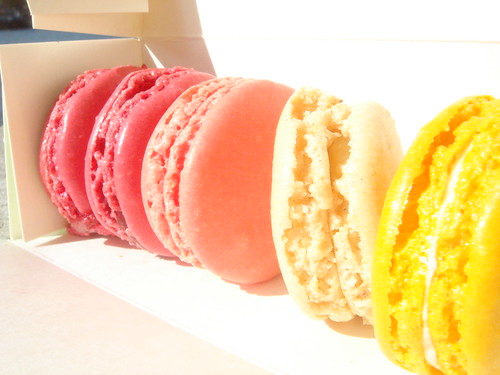 macaron by acme


.jpg)

 Posts
Posts


