This intro to a beguiling episode of Selected Shorts featuring work by Aimee Bender and Etgar Keret, written and read by Aimee Bender, struck me as one of those things that's both honest and inspirational and, of course, like most things writers write about writing, a little confessional. I found it so on the mark that I transcribed it and am putting it here, for you.
If for any reason you are either unfamiliar with Aimee Bender or Selected Shorts, both are well worth your time.
I wrote my story Drunken Mimi while working on my 1st book of stories, and largely it was coming from a feeling of grand freedom and permission. Finally I'd been encouraged enough to try using the words and structures of fairy tales for my own purposes, and even the idea of using a mermaid as a character, even to put the word mermaid on the page in a serious story, felt to me like running free in scarves thru the streets.
I had previously thought of stories as objects that had to conform to many rules. As rigid as jam jars. But I'd been thinking then that maybe the form was a little more flexible than I had realized, for example, I had not thought a story could be considered a real story unless the people in it were all people.
As with Etgar I think both of our stories tend to be about the playing out of consequences. You set up a skewed world and then you see what's in it. You mess with the logic, and then you follow the logical consequences of the change. It's both out there and also not. Everything doesn't go. There are rules always beneath the story structure. For me, by bending the usual rules I'm trying to access a feeling I can't quite get to otherwise. Often I'll feel inhibited trying to get to reality on the page. The page isn't reality anyway, it's a bunch of words, so a writer's job, I believe, is to try to be honest and pinpoint a genuine feeling or idea, to put on the page something we can look and and discuss. The reader can feel this.
Realism or not isn't what's important, what's important is what the captured or what the writer's trying to capture. The sincerity of the butterfly net. So in that way I see both Etgar and myself as trying to grab onto something ineffable, to frame a feeling with words, to hold it inside the inner working of a story and to tell it in the only was we know how, which is often thru a very strange lens.
You know that feeling when you're walking around in your day and you're maybe going to get a coffee and there's a faint remembrance of last night's dream that floats thru your mind? Sometimes it's so faint and wispy you can't quite catch it. That territory interests me quite a bit and Etgar's not here, he wanted to be but he couldn't be, but I bet it interests him as well. Trying to slow down the speed of thinking, to catch that butterfly of a memory or thought or image and to turn it around and look at it. This wisp of a thought is as much a part of who we are as the coffee we drink and the to-do lists we make, even once it has drifted back down into the darkness and the recesses.
Showing posts with label fiction writing. Show all posts
Showing posts with label fiction writing. Show all posts
Thursday, August 27, 2009


Thursday, July 16, 2009
effing amazing strawberry jam
I made this last week with Ace because my roomie brought home a flat of strawberries. I love this jam because it brings out the exact flavor you associate with a perfect, intense summer strawberry.
It's like eating sunshine. It brings out the very best red juicy splash of sweetness without any of that acid (though I'm sure you could kick it up with a couple lemons if you felt like you wanted acid).
Also, it's really easy! All you need are four cups of sugar, three pints of berries, one vanilla bean and one pot! De-stem the berries and cut them in half. Toss berries, vanilla bean and sugar in pot and let macerate for half an hour, then start cooking over medium-high heat. To reduce the foam, skim some of the syrup off the top once the sugar has melted and the berries are releasing juice. Save this stuff for a rad strawberry syrup for italian sodas, fancy martinis or an ice cream topping. Continue to cook the jam until the berries are cooked down and you've got a syrupy consistency.
Want more specific instructions than that? I understand. But I'm not an exact person when it comes to compotes, jams and the like. If you prefer your preserves with larger chunks of fruit then you can do something like this
Currently I'm listening to You Tube Magnetic Fields videos from love shows and working on ch 5 (five!) of the manuscript while drinking this stuff after a night at sfmoma seeing the awesome Avedon exhibit. Can't imagine a collection of things more appealing.
It's like eating sunshine. It brings out the very best red juicy splash of sweetness without any of that acid (though I'm sure you could kick it up with a couple lemons if you felt like you wanted acid).
Also, it's really easy! All you need are four cups of sugar, three pints of berries, one vanilla bean and one pot! De-stem the berries and cut them in half. Toss berries, vanilla bean and sugar in pot and let macerate for half an hour, then start cooking over medium-high heat. To reduce the foam, skim some of the syrup off the top once the sugar has melted and the berries are releasing juice. Save this stuff for a rad strawberry syrup for italian sodas, fancy martinis or an ice cream topping. Continue to cook the jam until the berries are cooked down and you've got a syrupy consistency.
Want more specific instructions than that? I understand. But I'm not an exact person when it comes to compotes, jams and the like. If you prefer your preserves with larger chunks of fruit then you can do something like this
Currently I'm listening to You Tube Magnetic Fields videos from love shows and working on ch 5 (five!) of the manuscript while drinking this stuff after a night at sfmoma seeing the awesome Avedon exhibit. Can't imagine a collection of things more appealing.
Tuesday, June 23, 2009
stuff that's keeping me happy lately
I've been so busy traveling. There's a lot that I want to tell you about but it's going to take a while. In the meantime here's a teaser of stuff that I've been into lately:

photo by James Callahan
- pilot books, seattle
- amazing apricots
- breaking news: harvard lays off 275 employees --> THIS IS NOT SOMETHING I LIKE
- molly moon's, seattle
- finding a gay friendly bakery in eugene or
- inner sunset farmers market, sf
- modesto jr. college egg farmers
- being so close to the end of chapter 3, phew!

photo by James Callahan
Sunday, June 14, 2009
Andre Dubis-isms
While searching my hotmail inbox for a recipe for rosemary-soy chicken wings, I unearthed an email from a grad school professor that contained a list of anecdotes about the esteemed writer Andre Dubus Sr.
Known among writers as "Andre Dubus the father," so as to distinguish the subject from his son, the Andre Dubus who authored The House of Sand and Fog, the elder Andre Dubus is known primarily for his rich and haunting short stories. Dubus is one of those people described frequently as a "writer's writer."
What does this mean? Certainly it ranks up there with the haughty-yet-cliched terms bandied about by teachers and students of writing in MFA classes and advanced-level college workshops. Both curse and blessing, being a writer's writer is like being crowned prom king AND valedictorian. Your writing is layered, rich, resonant (oh, cliche!), your endings are earned, your characters' dialogue is never petty nor trite.
Joking aside, what this means primarily is that you are someone aspiring writers need to have in their toolbox. You have something to teach writers--how to tell a good story--as well as readers. If you are a writer's writer, you might not be well-known by the general reading public.* You might not have a bestseller, or financial success. You are a rocks glass of smoky scotch beside a fireplace while soft snow settles onto the eaves of an old house. You are special.
Another of my professors was an old family friend of Andre D's, and had the pleasure of sitting through many a Red Sox game with the old man. He used to tell us stories of Andre's adoration for the gummy New England accent, and the hardworking-hard-drinking working class baseball fans you can encounter at Fenway.
While his Andre stories were more character-driven, the list of Dubus-ism I found portray not the man himself, but the quirks of a writer and the instructions in a practice.
*Dubus the father's short story Killings was adapted into the movie "In the Bedroom."
Known among writers as "Andre Dubus the father," so as to distinguish the subject from his son, the Andre Dubus who authored The House of Sand and Fog, the elder Andre Dubus is known primarily for his rich and haunting short stories. Dubus is one of those people described frequently as a "writer's writer."
What does this mean? Certainly it ranks up there with the haughty-yet-cliched terms bandied about by teachers and students of writing in MFA classes and advanced-level college workshops. Both curse and blessing, being a writer's writer is like being crowned prom king AND valedictorian. Your writing is layered, rich, resonant (oh, cliche!), your endings are earned, your characters' dialogue is never petty nor trite.
Joking aside, what this means primarily is that you are someone aspiring writers need to have in their toolbox. You have something to teach writers--how to tell a good story--as well as readers. If you are a writer's writer, you might not be well-known by the general reading public.* You might not have a bestseller, or financial success. You are a rocks glass of smoky scotch beside a fireplace while soft snow settles onto the eaves of an old house. You are special.
Another of my professors was an old family friend of Andre D's, and had the pleasure of sitting through many a Red Sox game with the old man. He used to tell us stories of Andre's adoration for the gummy New England accent, and the hardworking-hard-drinking working class baseball fans you can encounter at Fenway.
While his Andre stories were more character-driven, the list of Dubus-ism I found portray not the man himself, but the quirks of a writer and the instructions in a practice.
- Andre Dubus (father) wrote 100 pages to "find" the seven pages of his story "Waiting." It took him fourteen months.
- Andre Dubus always recorded how many words he wrote each day. And everytime he said "thank you." -- "28 words, thank you." OR "1200 words, thank you."
- Andre D was at a party once where there was a fistfight over whether something falls to "earth" or to "the ground." Carver was for "ground."
- Rick Russo said of Andre D's prose style "Once you are a Catholic you will be using that language the rest of your life, even if you don't believe in the dogma anymore."
- Russo said that reading Andre Dubus and Richard Yates when he was in an MFA program at the Univ. of Arizona saved him--because at the time everyone was reading Gass, Coover, Hawkes, Vonnegut, etc.
- Rick Russo quoting a friend: "Just becasue it didn't happen doesn't mean I can't remember it."
*Dubus the father's short story Killings was adapted into the movie "In the Bedroom."
Saturday, April 11, 2009
revisions, revisions
I got stuck on a chapter last night. I can usually tell when I'm stuck because I'm avoiding writing, or when I try to write I get nothing done (but sometimes I get so little done even when I'm not stuck). Last night I was trying to revamp a scene in a chapter that needs lots of work.
Group scenes are really hard for me. Parties. Crowded rooms. That stuff is a touch easier in first person because it's all being streamed through one voice. Third person, though...even if it's fairly limited, it's still something I have a hard time working with. All those bodies, what are they doing? I wrote a scant paragraph but no more.
Then I took a walk. Getting up and leaving the room is dangerous. When you're struggling to write, sometimes it works best to push through it, whether by giving yourself an arbitrary word count (500 more, = 2 pages) or by giving yourself an arbitrary time you must write until. I tend to try to stay in the room, even if it's not doing me any good. Even when I give into the urge to google this or that information that I really need to know, really before going any further. Getting up and leaving the room brings the danger that I won't sit back down at all. And leaving writing dissatisfied doesn't make me want to sit back down the next day.
Sometimes it also works to close the computer and let everything marinate overnight. If I've taken my characters up to the edge of a cliff, but not over the cliff, if I've started a new scene, gotten everyone into the next room, then I've got something to mull over and I've got a jumping-off point for the next day. This wasn't going to work because I knew the room they were entering, and they were all bottled up in the hallway.
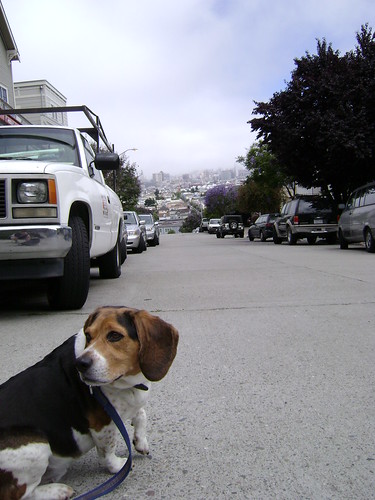
So I took a walk with my dog, down to the public garden. I thought about the scene I was struggling with. I thought it through enough that when we got home, half an hour or so later, I made a few notes on a post-it and got back to work, and finished the scene.
By and large, characters make rational decisions. They might not be rational to you, the reader; if so, the writer didn't do her job well enough. Stylistically, sure, sometimes we choose altogether unreliable, irrational characters. Logic will always play a role. If I choose an unreliable narrator, I've got to use my logic to demonstrate her total unreliability at some point in the story. If my narrator is confused, heartbroken, manic, earnest, what-have-you, but otherwise trustworthy, he or she will make a rational decision. Additional characters will react in time. Raymond Carver is so skilled at showing these decisions with such sparse language. Writers who clutter their pages (Dave Eggers comes to mind) likewise have to justify their decisions. I walked through the garden at night, took away my fear and frustration and anxiety, and laid everything out straight. What did my character want? Who was going in that room with him? What other characters would hover on the periphery? How could I introduce tension, foreshadowing, doubt, anything for his to react against? How could I introduce information about minor characters that could be useful in future chapters?
Sometimes, but very rarely, we need to leave the room and walk about. That scene is finished, almost. Tonight on my drive home I realized I need to spend a little more time on something. Always writers have to think about how we can raise the stakes, introduce more tension, cut closer to the bone.
That is, if we're writing about something honest and true that we care deeply about. It is infinitely easier to put words on a page if our hearts are not behind them. They lose a degree of power. Choices get abstracted.
Group scenes are really hard for me. Parties. Crowded rooms. That stuff is a touch easier in first person because it's all being streamed through one voice. Third person, though...even if it's fairly limited, it's still something I have a hard time working with. All those bodies, what are they doing? I wrote a scant paragraph but no more.
Then I took a walk. Getting up and leaving the room is dangerous. When you're struggling to write, sometimes it works best to push through it, whether by giving yourself an arbitrary word count (500 more, = 2 pages) or by giving yourself an arbitrary time you must write until. I tend to try to stay in the room, even if it's not doing me any good. Even when I give into the urge to google this or that information that I really need to know, really before going any further. Getting up and leaving the room brings the danger that I won't sit back down at all. And leaving writing dissatisfied doesn't make me want to sit back down the next day.
Sometimes it also works to close the computer and let everything marinate overnight. If I've taken my characters up to the edge of a cliff, but not over the cliff, if I've started a new scene, gotten everyone into the next room, then I've got something to mull over and I've got a jumping-off point for the next day. This wasn't going to work because I knew the room they were entering, and they were all bottled up in the hallway.
So I took a walk with my dog, down to the public garden. I thought about the scene I was struggling with. I thought it through enough that when we got home, half an hour or so later, I made a few notes on a post-it and got back to work, and finished the scene.
By and large, characters make rational decisions. They might not be rational to you, the reader; if so, the writer didn't do her job well enough. Stylistically, sure, sometimes we choose altogether unreliable, irrational characters. Logic will always play a role. If I choose an unreliable narrator, I've got to use my logic to demonstrate her total unreliability at some point in the story. If my narrator is confused, heartbroken, manic, earnest, what-have-you, but otherwise trustworthy, he or she will make a rational decision. Additional characters will react in time. Raymond Carver is so skilled at showing these decisions with such sparse language. Writers who clutter their pages (Dave Eggers comes to mind) likewise have to justify their decisions. I walked through the garden at night, took away my fear and frustration and anxiety, and laid everything out straight. What did my character want? Who was going in that room with him? What other characters would hover on the periphery? How could I introduce tension, foreshadowing, doubt, anything for his to react against? How could I introduce information about minor characters that could be useful in future chapters?
Sometimes, but very rarely, we need to leave the room and walk about. That scene is finished, almost. Tonight on my drive home I realized I need to spend a little more time on something. Always writers have to think about how we can raise the stakes, introduce more tension, cut closer to the bone.
That is, if we're writing about something honest and true that we care deeply about. It is infinitely easier to put words on a page if our hearts are not behind them. They lose a degree of power. Choices get abstracted.
Thursday, February 19, 2009
i need something new to read
...because I think I've worked my way through the following, not all of whom I completely love...or even like...but have indeed read.
Jonathan Franzen, Jonathan Lethem, Michelle Tea, Stacy D'Erasmo, Junot Diaz, Alison Bechdel, Adrian Tomine, George Saunders, Michael Chabon, Carole Maso, Ali Liebegott, Scott Heim, TC Boyle, Charles Baxter, Michael Cunningham, AM Homes, Jeanette Winterson, David Sedaris, Amy Bloom, and most feted short story collections of the recent past.
I haven't read the new Jhumpa Lahiri. I haven't read much Steve Almond (somehow...I must never leave the house). I have decided on this long-awaited piece and this hole in my collection.
Currently reading some Dashiel Hammett. Probably not good for my general blend of cynicism and anxiety.
Jonathan Franzen, Jonathan Lethem, Michelle Tea, Stacy D'Erasmo, Junot Diaz, Alison Bechdel, Adrian Tomine, George Saunders, Michael Chabon, Carole Maso, Ali Liebegott, Scott Heim, TC Boyle, Charles Baxter, Michael Cunningham, AM Homes, Jeanette Winterson, David Sedaris, Amy Bloom, and most feted short story collections of the recent past.
I haven't read the new Jhumpa Lahiri. I haven't read much Steve Almond (somehow...I must never leave the house). I have decided on this long-awaited piece and this hole in my collection.
Currently reading some Dashiel Hammett. Probably not good for my general blend of cynicism and anxiety.
Wednesday, February 11, 2009
overheard on the blogs
Many writer types reacting to the news that HarperCollins is shutting its Collins divisions (mostly nonfiction/reference). Over here someone asked if publishing companies would approach congress for a bailout.
After hours editing widgets I'm not so amused by that notion as when I first found it, but...as much as I'm entirely over death-of-the-novel* conversations, it is the end of an era.
I wonder how many kids today grow up relating to the tactile scent of a book's pages or the smell of grimy newspaper ink on their hands. If they parse the weight of textbook paper versus cheap paperback.
*(see also death-of-fiction-in-general-and-the-short-story-in-particular)
If I believed that resistance was futile, I would stop.
After hours editing widgets I'm not so amused by that notion as when I first found it, but...as much as I'm entirely over death-of-the-novel* conversations, it is the end of an era.
I wonder how many kids today grow up relating to the tactile scent of a book's pages or the smell of grimy newspaper ink on their hands. If they parse the weight of textbook paper versus cheap paperback.
*(see also death-of-fiction-in-general-and-the-short-story-in-particular)
If I believed that resistance was futile, I would stop.
Tuesday, February 03, 2009
introducing SAVE Creative Writing
How many people does it take to reach Anthony Bourdain?
One, if you're me and you know how to find him.
How many people does it take to reach America's writers? To be exact, the specific subset of writers that attended Vassar College?
I don't know. That's where you folk come in.
(FYI, Bourdain attended but did not graduate)
Currently, due to budget cuts, the creative writing program at Vassar is facing severe budget cuts. If passed they threaten to undermine the integrity of the creative writing program.
To follow the fight against these cuts and find out how you can help visit SAVE Creative Writing
One, if you're me and you know how to find him.
How many people does it take to reach America's writers? To be exact, the specific subset of writers that attended Vassar College?
I don't know. That's where you folk come in.
(FYI, Bourdain attended but did not graduate)
Currently, due to budget cuts, the creative writing program at Vassar is facing severe budget cuts. If passed they threaten to undermine the integrity of the creative writing program.
To follow the fight against these cuts and find out how you can help visit SAVE Creative Writing
Thursday, December 18, 2008
i've been hearing rumors
I came across some disturbing rumors that my old college is going to make significant cute to its creative writing department. My first reaction was to google it to see if there was any truth behind the rumors and it appears there is. like every other school, vassar is losing endowment money due to the economy. (i'm sure even harvard is having to cut back, but hey, i'd probably endorse that). My second reaction was to email an old favorite professor, now co-chair of the english department, to see if he could tell me a bit of what is going on. Most of all I'm shocked that the English Dept. did not notify alumnae...at least, I am pretty certain they did not, though I do sometimes miss an email.
Vassar is the place that formed me as a writer. Not the school where I received my masters. Not the countless days and hours writing in cafes or with fellow writers or alone at home. Sure, all of it helps. All of it forms the writer and all of it feeds the writer.
I chose to attend Vassar because I wanted to go to a school with a strong focus on English and writing. I was a high school geek. I worked on the lit mag. In college I built strong relationships with several faculty members, and I began to take my craft seriously. From there my life followed on its plan: spend a year or so working, go somewhere and get an MFA. That is what I did, and though there is nothing more invigorating than talking about writing in a room full of writers, it does not pay the bills or change the oil in the car, so I found myself having to get a career. Hence the cooking gig.
I'm researching the truth behind these rumors in the hopes I'll be proven wrong, but I doubt it. Times are tough everywhere. Academics is a luxury lifestyle, wherein each generation creates the next generation so the academy can be self sustaining. The trouble with writing, though, is that the classroom isn't our only classroom. Every face, every darkened door, every half-heard conversation is our classroom and in order to contribute to the growth of ourselves or of the next generation we have to go off alone and discover what we know, what we can say, and how we can share it.
I'll be blogging on here and at Fringe on what I discover.
Vassar is the place that formed me as a writer. Not the school where I received my masters. Not the countless days and hours writing in cafes or with fellow writers or alone at home. Sure, all of it helps. All of it forms the writer and all of it feeds the writer.
I chose to attend Vassar because I wanted to go to a school with a strong focus on English and writing. I was a high school geek. I worked on the lit mag. In college I built strong relationships with several faculty members, and I began to take my craft seriously. From there my life followed on its plan: spend a year or so working, go somewhere and get an MFA. That is what I did, and though there is nothing more invigorating than talking about writing in a room full of writers, it does not pay the bills or change the oil in the car, so I found myself having to get a career. Hence the cooking gig.
I'm researching the truth behind these rumors in the hopes I'll be proven wrong, but I doubt it. Times are tough everywhere. Academics is a luxury lifestyle, wherein each generation creates the next generation so the academy can be self sustaining. The trouble with writing, though, is that the classroom isn't our only classroom. Every face, every darkened door, every half-heard conversation is our classroom and in order to contribute to the growth of ourselves or of the next generation we have to go off alone and discover what we know, what we can say, and how we can share it.
I'll be blogging on here and at Fringe on what I discover.
Tuesday, August 12, 2008
#300 /why oscar wao
Trying to get back to the simple things in life now that my company's gone. Like cooking dinner at least once a week, calling up those I haven't seen in a long time, continuing to turn our Sunset house into a den of fabulous (or frivolous) decoration. And writing, and reading.
What I loved about Oscar Wao was that it was so different from Drown. Drown, though beautifully written, embraced at times a sort of ghetto chic perspective of difference. In writing that sometimes bordered on romanticism Diaz brought for slices of life (the Jersey/Washington Heights DR diaspora, the realities of growing up on food stamps not knowing your father, the clannish intensities of (im)migrant neighborhoods) that were, yes, missing from "contemporary fiction." Over and over, tough-boy narrator Yunior held forth that you could look through the window but you would not know, in a manuscript that held difference over assimilation or non-assimilation, in a way of speaking that made space for otherness/queerness/difference apart from (not of nor in).
Wao, though, is the nerd-chic fatboy younger brother of Drown-era Diaz. It's Diaz's Corrections, his Caramelo, his Middlesex. Wao takes on the language of RPGs and fantasy books, movies, D&D as much as it draws on Spanish-inflected English and Dominican history. The books is so round, and so real, that reading it I forgive the tired genre it stems from...the old family history stretching back in time, that so masculine snapshot-of-three-generations, this is the key, the thread, the connection. This sort of grand family planning seems to be the archetype of our time, that and memoir, and even David Sedaris bridges the gap (both archetypes! one book!) For as much as I love so many of those books I'm ready for something else to capture our collective literary imagination, but until it does, I'll hope it doesn't take 11 more years of nationwide literary-geek snickering til Diaz produces another piece, and I'm hoping that those of us on the margins will continue to take on the constructs of the center to break apart more open spaces.
What I loved about Oscar Wao was that it was so different from Drown. Drown, though beautifully written, embraced at times a sort of ghetto chic perspective of difference. In writing that sometimes bordered on romanticism Diaz brought for slices of life (the Jersey/Washington Heights DR diaspora, the realities of growing up on food stamps not knowing your father, the clannish intensities of (im)migrant neighborhoods) that were, yes, missing from "contemporary fiction." Over and over, tough-boy narrator Yunior held forth that you could look through the window but you would not know, in a manuscript that held difference over assimilation or non-assimilation, in a way of speaking that made space for otherness/queerness/difference apart from (not of nor in).
Wao, though, is the nerd-chic fatboy younger brother of Drown-era Diaz. It's Diaz's Corrections, his Caramelo, his Middlesex. Wao takes on the language of RPGs and fantasy books, movies, D&D as much as it draws on Spanish-inflected English and Dominican history. The books is so round, and so real, that reading it I forgive the tired genre it stems from...the old family history stretching back in time, that so masculine snapshot-of-three-generations, this is the key, the thread, the connection. This sort of grand family planning seems to be the archetype of our time, that and memoir, and even David Sedaris bridges the gap (both archetypes! one book!) For as much as I love so many of those books I'm ready for something else to capture our collective literary imagination, but until it does, I'll hope it doesn't take 11 more years of nationwide literary-geek snickering til Diaz produces another piece, and I'm hoping that those of us on the margins will continue to take on the constructs of the center to break apart more open spaces.
Sunday, March 30, 2008
reading: amy bloom, away
I've been a big Amy Bloom fan for a while, ever since Love Invents Us. She writes mostly contemporary fiction (novels, short stories) and always features queer characters of some sort in her writing, which is something I always find really interesting. But I wasn't very excited to read Away, a novel set in 1920s America chronicling a Russian Jew searching for her long-last daughter via an overland journey from New York to Siberia. Originally it was Bloom's prose more than the story that won me over...the story seemed like a mishmash of all the other narratives of displacement, rootlessness. The plucky female heroine immigrant road trip, or at least that's how the logline for the movie would read.
I read the book in a day...can't remember the last time I did that. I had two MUNI rides to get started, and stayed up late turning the pages. The details were vivid, sharp, unique. There was the requisite backstory (think Beloved, think Lipshitz Six), a horror story of violence, and that threaded repeatedly through the book.
What turned me off from the book was Bloom's habit of flashing forward. Since the book is a road narrative, the main character leaves every character she encounters, and all those characters give her something (physical or psychic, tangible or immaterial) to push her on her journey...and each time the MC leaves, Bloom offers a paragraph summary of where that person ends up. This is how he dies, or lives, this is where she goes. It's cute...it's the gratification of the reader impulse to "know where" the secondary characters end up, because they/we have come to care about these characters. But it gets old. It gets annoying. Especially as the book nears to a close.
I think it's in part the gimmicks of omniscience that turn me off of third person fiction. The author's tidy tricks. Life is much messier than that. In reality, those characters fade away. It's interesting to think about the novel's weak points in relation to my own work.
I've been writing a lot, especially on MUNI...put on the ipod and go. It feels really good. I'm writing a lot about food and it allows me a place to push against things, think things over.
I read the book in a day...can't remember the last time I did that. I had two MUNI rides to get started, and stayed up late turning the pages. The details were vivid, sharp, unique. There was the requisite backstory (think Beloved, think Lipshitz Six), a horror story of violence, and that threaded repeatedly through the book.
What turned me off from the book was Bloom's habit of flashing forward. Since the book is a road narrative, the main character leaves every character she encounters, and all those characters give her something (physical or psychic, tangible or immaterial) to push her on her journey...and each time the MC leaves, Bloom offers a paragraph summary of where that person ends up. This is how he dies, or lives, this is where she goes. It's cute...it's the gratification of the reader impulse to "know where" the secondary characters end up, because they/we have come to care about these characters. But it gets old. It gets annoying. Especially as the book nears to a close.
I think it's in part the gimmicks of omniscience that turn me off of third person fiction. The author's tidy tricks. Life is much messier than that. In reality, those characters fade away. It's interesting to think about the novel's weak points in relation to my own work.
I've been writing a lot, especially on MUNI...put on the ipod and go. It feels really good. I'm writing a lot about food and it allows me a place to push against things, think things over.
Tuesday, February 26, 2008
the sordid details...
(because the monkey wrangler asked)
1. the "who am I really?": For a long time when you googled me (which is to say when I googled myself) the first thing you saw was this: Toby Reid is a faggot Jew. It was the first sentence of a story I wrote and had published. It's actually a really good piece and I still love it, but I always wondered if people randomly coming across it would think I was a bigot. Also, in grad school I wrote a story on terrorism that involved me googling things like "how to make bombs" and "how to get away with arson" so the government probably thinks I'm nuts. And now you all can as well.
2. the "those crazy queers": When I was a kid and my first lil brother was born I was really upset he wasn't a girl. So one time I dressed him up in some old dress I had and my first communion veil and paraded him around the house. He was pre-mobile at the time so let's hope he has no vague memory of it to trouble his masculinity, because lil brothers are fun.
3. the "gold star": I've only ever seen one man naked and that was because I was 25 and confessed to him that fact. He's actually my oldest friend out here in California...
4. the "stupid pastry assistant, no. 1": At my first restaurant job, my boss was having me make an anglaise and a creme brulee base (or it may have been a pot de creme and brulee, but you get the pictures. eggs tempered, custard, etc). So halfway through the process, when I'd brought everything upstairs to the stove and was just waiting on the cream to come to boil, I became convinced I'd put all the sugar in one of the pots and none in the other (save whatever amount was whisked with the yolks). Rather than admit my stupidity, I went ahead with both projects. Since we made desserts for three restaurants and one of these projects was for a distant location, I never really did find out if it was all in my head or if I really fucked up a lot of food. Oops.
5. the "violence against literature": Recently I took The Last Course out of the library (back in Boston, because SF just has no love for Claudia Fleming) out of the library and photocopied the whole thing because I can't afford to buy a marked-up ebay copy and it's out of print. So I have the most ghetto version of that cookbook, but it's okay, I still love it. Also, years ago when I worked at a bookstore I was so fed up with things in my life that I would rip pages in the back of the travel guides. Customers would be able to bring them back for a new copy...plus people would just take them and read them on the floor so lots were pretty banged up anyway.
I truly hope my mom doesn't read this. Now, who to tag?
Budi, even though he probably won't comply because he rarely posts. But every now and then he busts out with an interesting tale from his past, which cracks us all up because now he's spiritual advisor and mediator to the cupcakery.
Richie, because I met him for a half second one day...and because reading his blog I just get the feeling he's got some interesting stories.
Fringe, because this is an ideal project for writers, and I have to post this week so let's conserve out stones, eh?
Jamey, again, with the writers.
and lastly, Maryusa, because she is just so much trouble and who knows what wildness she's committing with her one functional hand!
oh, & the rules:
1. Link to your tagger and post these rules.
2. Share 5 facts about yourself.
3. Tag 5 people at the end of your post and list their names, linking to them.
4. Let them know they've been tagged by leaving a comment at their blogs.
1. the "who am I really?": For a long time when you googled me (which is to say when I googled myself) the first thing you saw was this: Toby Reid is a faggot Jew. It was the first sentence of a story I wrote and had published. It's actually a really good piece and I still love it, but I always wondered if people randomly coming across it would think I was a bigot. Also, in grad school I wrote a story on terrorism that involved me googling things like "how to make bombs" and "how to get away with arson" so the government probably thinks I'm nuts. And now you all can as well.
2. the "those crazy queers": When I was a kid and my first lil brother was born I was really upset he wasn't a girl. So one time I dressed him up in some old dress I had and my first communion veil and paraded him around the house. He was pre-mobile at the time so let's hope he has no vague memory of it to trouble his masculinity, because lil brothers are fun.
3. the "gold star": I've only ever seen one man naked and that was because I was 25 and confessed to him that fact. He's actually my oldest friend out here in California...
4. the "stupid pastry assistant, no. 1": At my first restaurant job, my boss was having me make an anglaise and a creme brulee base (or it may have been a pot de creme and brulee, but you get the pictures. eggs tempered, custard, etc). So halfway through the process, when I'd brought everything upstairs to the stove and was just waiting on the cream to come to boil, I became convinced I'd put all the sugar in one of the pots and none in the other (save whatever amount was whisked with the yolks). Rather than admit my stupidity, I went ahead with both projects. Since we made desserts for three restaurants and one of these projects was for a distant location, I never really did find out if it was all in my head or if I really fucked up a lot of food. Oops.
5. the "violence against literature": Recently I took The Last Course out of the library (back in Boston, because SF just has no love for Claudia Fleming) out of the library and photocopied the whole thing because I can't afford to buy a marked-up ebay copy and it's out of print. So I have the most ghetto version of that cookbook, but it's okay, I still love it. Also, years ago when I worked at a bookstore I was so fed up with things in my life that I would rip pages in the back of the travel guides. Customers would be able to bring them back for a new copy...plus people would just take them and read them on the floor so lots were pretty banged up anyway.
I truly hope my mom doesn't read this. Now, who to tag?
Budi, even though he probably won't comply because he rarely posts. But every now and then he busts out with an interesting tale from his past, which cracks us all up because now he's spiritual advisor and mediator to the cupcakery.
Richie, because I met him for a half second one day...and because reading his blog I just get the feeling he's got some interesting stories.
Fringe, because this is an ideal project for writers, and I have to post this week so let's conserve out stones, eh?
Jamey, again, with the writers.
and lastly, Maryusa, because she is just so much trouble and who knows what wildness she's committing with her one functional hand!
oh, & the rules:
1. Link to your tagger and post these rules.
2. Share 5 facts about yourself.
3. Tag 5 people at the end of your post and list their names, linking to them.
4. Let them know they've been tagged by leaving a comment at their blogs.
Friday, February 08, 2008
first person, limited
(or, I am such a one trick pony, kids...)
In what jargon do you talk? What are your buzz words?
Do you confuse the narrator with the character or with the author? Do you think that you don't need to figure out who is narrating a third person piece? What is at stake for that omniscience? Do you thrive on voice, the slow seduction of one person's confessions(I want to say that I met the apple farmer, Dan, in a cute way)? What do you know of pacing and rhythm, sentence structure? (As luck would have it, I knew the girl who showed up to interview me for the new SF food magazine--as if our tiny city really needed another--and she in turn knew that I was a dyke.)What do you know of beginnings?(Occasionally, something happens in a kitchen, good or bad--so you save the day by covering three stations and cooking for some hotshot food critic, or else you get caught drinking champagne and doing lines of coke in the wine room and your coworkers lock you in overnight just for kicks--and you ascend right into legend) Do you conceive or do you write blindly on? Do you seek to place metaphor, stories, do you make use of dreams or gimmicks (Six months ago I flew to Anchorage to watch my father die and last month he returned the favor)
tense. backstory. scene. exposition. reliability, in narrators. trust. stakes. beginning middle end. protagonist. syntax. prose. word choice. intention. description. dialogue. believability. first person limited/omniscient second person third.
If you know me by now, you know I need to know all the details
There are so many rules, strategies, modes and things to say but all it really takes is my left hand moving. To keep a million things in mind, and still perform the task at hand which is informed by those millions of things, born from them as surely as anything is created. To hold all of the necessary knowledge, and go forth quietly down one path willing to wait for what needs to happen to happen, to get there in the necessary manner, which is different every time, though similar.
In what jargon do you talk? What are your buzz words?
Do you confuse the narrator with the character or with the author? Do you think that you don't need to figure out who is narrating a third person piece? What is at stake for that omniscience? Do you thrive on voice, the slow seduction of one person's confessions(I want to say that I met the apple farmer, Dan, in a cute way)? What do you know of pacing and rhythm, sentence structure? (As luck would have it, I knew the girl who showed up to interview me for the new SF food magazine--as if our tiny city really needed another--and she in turn knew that I was a dyke.)What do you know of beginnings?(Occasionally, something happens in a kitchen, good or bad--so you save the day by covering three stations and cooking for some hotshot food critic, or else you get caught drinking champagne and doing lines of coke in the wine room and your coworkers lock you in overnight just for kicks--and you ascend right into legend) Do you conceive or do you write blindly on? Do you seek to place metaphor, stories, do you make use of dreams or gimmicks (Six months ago I flew to Anchorage to watch my father die and last month he returned the favor)
tense. backstory. scene. exposition. reliability, in narrators. trust. stakes. beginning middle end. protagonist. syntax. prose. word choice. intention. description. dialogue. believability. first person limited/omniscient second person third.
If you know me by now, you know I need to know all the details
There are so many rules, strategies, modes and things to say but all it really takes is my left hand moving. To keep a million things in mind, and still perform the task at hand which is informed by those millions of things, born from them as surely as anything is created. To hold all of the necessary knowledge, and go forth quietly down one path willing to wait for what needs to happen to happen, to get there in the necessary manner, which is different every time, though similar.
Thursday, February 07, 2008
When I kissed Jessie in Kiki's woodshed two days before the bang-up party, I thought it was an accident, some kind of kinetic result of the hours spent carving ice with chisel and saw. I thought it was all over that day, before it even began.
Apparently I really did want to get some writing done yesterday. Tomorrow I plan to do a lot more. I remember an evening spent in a cafe, was it the first of the year? Writing a letter to keep me inspired to write. Trying to combat the loss of a year's work with grace, good humor and good company.
The best people are the ones that can make you laugh. Especially if you have just done something stupid or are in a lot of pain. I got the perfect email tonight from the only person who could have sent it to me. It made me feel a lot better in a way that talking to that same person would not have done.
Sometimes you are wrong about something and what do you do about that fact, your wrongness? How do you betray your character in your response? The dog barks; I am who I am as well.
Curiously, the dog seems much happier here in Oakland. No more yappy dogs!

Apparently I really did want to get some writing done yesterday. Tomorrow I plan to do a lot more. I remember an evening spent in a cafe, was it the first of the year? Writing a letter to keep me inspired to write. Trying to combat the loss of a year's work with grace, good humor and good company.
The best people are the ones that can make you laugh. Especially if you have just done something stupid or are in a lot of pain. I got the perfect email tonight from the only person who could have sent it to me. It made me feel a lot better in a way that talking to that same person would not have done.
Sometimes you are wrong about something and what do you do about that fact, your wrongness? How do you betray your character in your response? The dog barks; I am who I am as well.
Curiously, the dog seems much happier here in Oakland. No more yappy dogs!
Sunday, February 03, 2008
big drama in lil oaktown!
Sooo, I have lived here for two days, mostly one, and much of that was not spent at home. How can there be drama already? Dios mio. It didn't involve me, but I was brought up to speed, shall we say, by one of the guys in the house after a nightttime visit to my friend at the world's cutest ice cream shop.
(butterscotch and chocolate, and tastes of other delicacies)
The space feels different and the darkness feels different, would be what I have to say so far about being here in Oakland again. Mostly right now, though, all I want to do is sleep and I think it's some sort of response to stress. I got up at ten and then napped for a good couple hours this afternoon and I'm cozy in bed already.
In truth, though, I'm falling in love with reading again, and I'm not sure if I can convey the deliciousness of feeling cozy and safe in bed at home again (oh, and let's not forget warm!). It could be better if I had a warm body beside me, certainly, but my ears don't have to prick up for the footfalls of the old landlady or the yapping of small chihuahua dogs. I have had my guard up for a long time, almost all the time, and it is very exhausting, so perhaps that explains the sleep.
The book this time is Jane Smiley's Horse Heaven, a book I resisted reading for a long time because, cmon, it sounds like a book for horsey teenaged girls (or boys). Jane Smiley is a treat in the ironic, slightly embittered and witty way that is not really cynical enough to be in fashion right now. She is an Iowan, a reedy woman with big glasses and a small, tight frame who, improbably, went to Vassar, and I got to see her read there a number of years ago. One of the most intriguing things for me about Horse Heaven is how this woman can write so knowledgeable about the racetracks of California or Florida or the specifics of horse betting, training, horse care, all of it done from the various perspectives of owners, trainers, jockeys, trophy wives. I adore fiction that aims to be so much larger than life. I have always been attracted to multiplicity, to the perspective that doesn't quite fit, to the demolition of the idea of the box. I want the world to be large enough for stories that don't fit inside the frame, for stories with longing to be more than might contain them. It's time to turn my energies to writing again, with the house drama mostly behind me.
(butterscotch and chocolate, and tastes of other delicacies)
The space feels different and the darkness feels different, would be what I have to say so far about being here in Oakland again. Mostly right now, though, all I want to do is sleep and I think it's some sort of response to stress. I got up at ten and then napped for a good couple hours this afternoon and I'm cozy in bed already.
In truth, though, I'm falling in love with reading again, and I'm not sure if I can convey the deliciousness of feeling cozy and safe in bed at home again (oh, and let's not forget warm!). It could be better if I had a warm body beside me, certainly, but my ears don't have to prick up for the footfalls of the old landlady or the yapping of small chihuahua dogs. I have had my guard up for a long time, almost all the time, and it is very exhausting, so perhaps that explains the sleep.
The book this time is Jane Smiley's Horse Heaven, a book I resisted reading for a long time because, cmon, it sounds like a book for horsey teenaged girls (or boys). Jane Smiley is a treat in the ironic, slightly embittered and witty way that is not really cynical enough to be in fashion right now. She is an Iowan, a reedy woman with big glasses and a small, tight frame who, improbably, went to Vassar, and I got to see her read there a number of years ago. One of the most intriguing things for me about Horse Heaven is how this woman can write so knowledgeable about the racetracks of California or Florida or the specifics of horse betting, training, horse care, all of it done from the various perspectives of owners, trainers, jockeys, trophy wives. I adore fiction that aims to be so much larger than life. I have always been attracted to multiplicity, to the perspective that doesn't quite fit, to the demolition of the idea of the box. I want the world to be large enough for stories that don't fit inside the frame, for stories with longing to be more than might contain them. It's time to turn my energies to writing again, with the house drama mostly behind me.
Friday, January 18, 2008
happy friday!
I just finished the most strange and wonderful book this morning, Michael Chabon's The Yiddish Policemen's Union. I wasn't in love with Kavalier and Clay, so I didn't rush to pick it up and got it actually only out of desperation as they'd closed off the fiction section of the SFPL to move it all downstairs and there was nothing else. But it was great in the way that Jonathan Lethem's Motherless Brooklyn was great and Jonathan Franzen's The Corrections was great...
all those big boys and their big books, they bite off such large chunks of the world. Mysticism, religion, faith, noir, and a most unusual language all its own. And I am left to wonder what all these hours and words add up to...how to best proceed with my own work which, let's be honest, has always been trying to embrace too much of the world and too many voices. Multiplicity, borderlines, the random action, the long backstory. I am not one, writing wise, for straight lines and simple stories. It is safe to say you will never find my writing in the New Yorker. I know who I am.
I've got to type up my first submission for the new year's writing resolution pact and send it off to snowy Boston. Somehow I forgot that if we finish the year out we are going to get matching tattooes...
It's a restaurant story this part, but the next part of the story refuses to take shape. It balks after four or five re-starts, an angry line cook descending into bad habits while my lovelorn pastry chef sighs patiently over her perfect man and my gay manager stares down another glass of something waiting for reckognizeable love. Anthony Bourdain it ain't, but I have been trying to write these stories for long time and it's a lot easier when you are in a restaurant, squeezing past each other all the time, forming and reforming strange alliances, meeting the demands of the day with what grace you can muster.
This week has been strange and long, pastry bending once again to accommodate the work of others, which is fine, claro, but more juggling. Sometimes you don't sell a dessert for three days straight and then on the fourth you're suddenly shorthanded at the end of lunch service because it was all anyone seemed to want that day. Chances are whenever you think tonight will be just like last night that is not going to happen at all. When you wouldn't mind getting out of work early because you have an evening full of appointments, you'll stay late. You'll realize that there really are five ways of doing math because everyone sees things differently. You try to be always consistent and then the rule changes.
Consistency is hard, maybe one of the hardest things.
all those big boys and their big books, they bite off such large chunks of the world. Mysticism, religion, faith, noir, and a most unusual language all its own. And I am left to wonder what all these hours and words add up to...how to best proceed with my own work which, let's be honest, has always been trying to embrace too much of the world and too many voices. Multiplicity, borderlines, the random action, the long backstory. I am not one, writing wise, for straight lines and simple stories. It is safe to say you will never find my writing in the New Yorker. I know who I am.
I've got to type up my first submission for the new year's writing resolution pact and send it off to snowy Boston. Somehow I forgot that if we finish the year out we are going to get matching tattooes...
It's a restaurant story this part, but the next part of the story refuses to take shape. It balks after four or five re-starts, an angry line cook descending into bad habits while my lovelorn pastry chef sighs patiently over her perfect man and my gay manager stares down another glass of something waiting for reckognizeable love. Anthony Bourdain it ain't, but I have been trying to write these stories for long time and it's a lot easier when you are in a restaurant, squeezing past each other all the time, forming and reforming strange alliances, meeting the demands of the day with what grace you can muster.
This week has been strange and long, pastry bending once again to accommodate the work of others, which is fine, claro, but more juggling. Sometimes you don't sell a dessert for three days straight and then on the fourth you're suddenly shorthanded at the end of lunch service because it was all anyone seemed to want that day. Chances are whenever you think tonight will be just like last night that is not going to happen at all. When you wouldn't mind getting out of work early because you have an evening full of appointments, you'll stay late. You'll realize that there really are five ways of doing math because everyone sees things differently. You try to be always consistent and then the rule changes.
Consistency is hard, maybe one of the hardest things.
Wednesday, January 02, 2008
from the self loathing letter
The rules of engagement with my body of (lost) work for the next year, as outlined over brunch in Jamaica Plain with a dear friend, are thus:
1. work to be exchanged every 2 weeks, or once a month per participant.comments in on the alternate weeks.
2. occasional writing texts to be read and discussed.
3. our pieces of long work to be referred to as projects, rather than that nasty n word or any other such word.
4. an attempt made to join the larger writing community in our respective city, whether it be going to readings frequently, finding a writing buddy or joining a book club. we find outselves each in fabulous writing cities.
5. a letter to ourselves to be written and exchanged containing all of the fears and self criticisms we fall back on when we do not write. such letter containing all our worst barbs shall be read aloud by the other on the occasion of failing to turn in work on one's assigned date.
Last night I wrote my letter while chilling with Morgan at Ritual. I went through all of the usual criticisms, such as:
When was thelast time you spent more than 15 minutes working on a story? And that made you feel accomplished? Fucking pathetic. You spend more time than that making veloute.
And then halfway through something kept tugging at my mind. This lil cook part of me was urgently staying my pen arm. I realized that I needed to give myself permission to want to be a better cook also. Because when you cook and write it is a constant battle. They draw in the same resources and inspiratiomn, demand the same dedication and eye for detail, and craft and love, and my cook told me that she needed to be in this letter, too. Thus:
It's ok that you want to be a better cook. It's ok that you love your job. But you are not going to give up everything that you have wanted all your life and everything you think you are to be a cook. You don't have to make that a choice. You just need to stop wasting your time. You need to get to work. And it's not always fun.
So work, and then work.
1. work to be exchanged every 2 weeks, or once a month per participant.comments in on the alternate weeks.
2. occasional writing texts to be read and discussed.
3. our pieces of long work to be referred to as projects, rather than that nasty n word or any other such word.
4. an attempt made to join the larger writing community in our respective city, whether it be going to readings frequently, finding a writing buddy or joining a book club. we find outselves each in fabulous writing cities.
5. a letter to ourselves to be written and exchanged containing all of the fears and self criticisms we fall back on when we do not write. such letter containing all our worst barbs shall be read aloud by the other on the occasion of failing to turn in work on one's assigned date.
Last night I wrote my letter while chilling with Morgan at Ritual. I went through all of the usual criticisms, such as:
When was thelast time you spent more than 15 minutes working on a story? And that made you feel accomplished? Fucking pathetic. You spend more time than that making veloute.
And then halfway through something kept tugging at my mind. This lil cook part of me was urgently staying my pen arm. I realized that I needed to give myself permission to want to be a better cook also. Because when you cook and write it is a constant battle. They draw in the same resources and inspiratiomn, demand the same dedication and eye for detail, and craft and love, and my cook told me that she needed to be in this letter, too. Thus:
It's ok that you want to be a better cook. It's ok that you love your job. But you are not going to give up everything that you have wanted all your life and everything you think you are to be a cook. You don't have to make that a choice. You just need to stop wasting your time. You need to get to work. And it's not always fun.
So work, and then work.
Tuesday, January 01, 2008
...
what to do when your hard drive crashes and you lost the entire last year's worth of your work as a writer...if you can even call yourself that anymore...i'm around sort of, figuring out what needs to happen and how i need to change and trying to make better habits.
fuck me, when i'm thinking i should feel loss about something the universe hands me a new conception of loss.
fuck me, when i'm thinking i should feel loss about something the universe hands me a new conception of loss.
Monday, December 17, 2007
...
sometimes i feel so happy
sometimes i feel so sad
sometimes i feel so happy
but mostly you just make me mad
baby you just make me mad
It snows in my mind and in the town where my friends live, spread out across the country. This morning I got an email from an old college friend saying she's moved to New York.
This is not about cooking, but it is. When I moved out here somehow slowly I lost touch with most of my friends back east, which is to say all of my friends except for the one who helped me come out here and those that are new. My old friends, I saw them all in September for a day or an hour, and since then we really haven't spoken. It's not the fault of the restaurant. It's three thousand miles of continent and times zones and the fact that when I'm not working they're either working or sleeping, and though everyone would love to get on a plane and come out to sunny California, no one has any money. I dreamed about a married friend last night. In college we lived together. We're both writers and we both blog. But we don't ever talk.
I'm trying to start trying again. Yesterday I called an old friend and we talked for a good hour. I'd seen him in New York and been in touch with him precisely once since then, at his count.
There's snow in my mind, but I'm not sure why. Is it my lifelong conditioning that the holidays be cold?
I get this way under a lot of stress. Stress....my mother asked me the other day why I was so stressed out over work these days. You Weren't When I Visited, she said. It's The HOLIDAYS I told her. I'll Have A Life In JANUARY But Right Now This Is My Life.
I wrote last night and it felt nice. There's so much editing, reading work to do for Fringe, maybe something else coming up too. I'd sort of like to go to a reading again one of these days...The Stephen Elliot piece in the Chronicle yesterday made me homesick for the company of writers.
Can't say for sure but it looks like I might see snow yet. But only because of sad things...
Monday, December 10, 2007
writing and the MFA
Are you an artist? Do you claim that word? Do you actively avoid it?
Do you think about the difference between art and craft and art and food and art and life? Do you miss photography before everyone became a photographer? Do you remember what paint smells like? Or old books?
How do you make your living? Are you doing something you love, or something you always wanted to do? Are you doing what comes easy to you? If you are working for money do you dream of a different life, where you can do something rewarding if not financially so? If you are poor do you dream about shucking it all away and making piles upon piles of money, somehow, someday?
How do you support yourself and are you doing a good job at it? How do you continue to make art when you no longer have a community for it? When society has no great need to consume it?
This week over at the Fringe blog I have some suggestions for newly-minted MFA holders (otherwise known as The Useless Degree). Pop over and add some suggestions of your own?
Do you think about the difference between art and craft and art and food and art and life? Do you miss photography before everyone became a photographer? Do you remember what paint smells like? Or old books?
How do you make your living? Are you doing something you love, or something you always wanted to do? Are you doing what comes easy to you? If you are working for money do you dream of a different life, where you can do something rewarding if not financially so? If you are poor do you dream about shucking it all away and making piles upon piles of money, somehow, someday?
How do you support yourself and are you doing a good job at it? How do you continue to make art when you no longer have a community for it? When society has no great need to consume it?
This week over at the Fringe blog I have some suggestions for newly-minted MFA holders (otherwise known as The Useless Degree). Pop over and add some suggestions of your own?
Subscribe to:
Posts (Atom)
.jpg)

 Posts
Posts


