Wednesday, August 19, 2009

Shawangunk Mountain Wild Blueberry & Huckleberry Festival

If you find yourself in the vicinity of the Gunks this coming weekend {which is to say, somewhere between the Catskills and Westchester, or, say, at the CIA or if you even changed to be in Binghamton, you could get there too, yessir}


then please go to the huckleberry festival.
go in my stead.


gunks photo c i eated a cookie
On the west coast they would have you believe that the only true foraged huckleberries come from the pacific northwest. This is simply incorrect as I found out last week while passing thru sleepy Ulster County. What little literature there is on this rad event says

"A celebration of the Shawangunk Mountains: music, BBQ, all-blueberry bake sale and pie judging contest, crafts and cultural area and art center, 9:00AM-4:00PM." Held somewhere in the town of Ellenville NY.

Huckleberries have been a foraged crop for hundreds of years, possibly dating back to 400 AD if you believe geologists.

If you're lucky you'll catch the eyes of an old-timey huckleberry picker who used to pick crops when the only roads between sleepy Hudson Valley towns were dirt carriage roads.

If you miss the festival you can still pick some huckleberries {now, not so much later} on the Minnewaska trails and elsewhere, though you might have to find a friendly local to share her berry spot.

Huckleberries are challenging to find commercially and expensive when you do find there because you're most often paying for a forager to traipse after them. Hunkleberries are smaller than blueberries and give a more complex flavor, though there are plenty of other differences too.

Thursday, July 30, 2009

why servers should pay attention at line-up and in tastings

true conversation from dinner last night...

me: we'd like to get dessert but we can't decide between the corn crepes with blueberries an the pink peppercorn vacherin with strawberry ice cream
server: well i'd really recommend the vacherin. it's a meringue cookie topped with strawberry ice cream and pistachios and there's strawberries too, and we make the ice cream in-house
me: oh...so you don't make the corn ice cream in house?
him: no, we do, we make all our ice cream in house
me: well how do you prepare the blueberries for the crepes?
him: we render them down in the pan
{at this point i shoot my friend a worried look. i don't believe the word "render" should be used in connection to food unless it's meat. it sounds kinda gross otherwise}
me: how's the lime caramel
him: zesty and delicious

It went on like that for a bit longer before we ordered the vacherin. The server did send us the crepes on the house, which was a nice touch especially since we hadn't complained about any aspect of the meal. Seems like he was just being nice.

Servers don't seem to realize that the restaurant actually makes a lot of money on dessert. Compared to that dungeness crab or rabbit meat the cost to the house of preparing a plate of dessert is very, very minimal whereas the cost of the meat, vegetables and other ingredients going into a main course is vastly pricier. The server, likely, is thinking that $8 on a dessert won't make a lot of money on his tip whereas that $12 app would be a bigger upsell.

What the average server does not realize is that most people get happier when they eat dessert. They relax, they linger and they're in a more generous mood when they're putting that tip out. Plus, the dessert money does add to the bill. It's the role of the server in this course more so than others to really sell the food. Whereas you might sit down in a restaurant and "be in a fish mood" and have two choices, you'll not likely be "in a pie mood" or "in a bread pudding mood" when it comes time for dessert {chocolate mood, maybe? but there'll always be warn choco cake for you}

Patrons are often more indecisive when it comes to desserts and they'll look to you, lil server. Do them, do your tip, do your boss and do the kitchen a favor and steer them toward something that'll taste really good. Do you need some tips on how to do this? Ok, well for starters:
1. Don't tell them to get the last thing the kitchen put up for you at line-up because it's the only thing you remember the taste of. This is silly. If you tried something new and it was awesome, that's fine, but if you can only remember the one thing then you're not doing your job because there's likely 4-5 other menu options.
2. Learn a new vocabulary. Words like "render" and "zesty" and (yes, even) "housemade" don't actually communicate anything at all. They don't tell me what it's going to taste like. Tastes like homemade? Great! For these prices I'd hope you actually make it. Seriously...
3. Learn how to describe something unique about the option. I should get the vacherin because you make the ice cream in house and it's got strawberries in it? Would you urge me to get the heirloom tomato salad because it contains purple tomatoes? Would you have me eat the scallops because they're pan-seared?

What you can do is say "our crepes are made fresh to order" {which they're probably not} or "the blueberries have an awesome flavor right now" or "the vacherin is coming off the menu soon so you might want to try it." Do you see how these phrases are different? They communicate something to me. A freshness, a quality, even a sense or urgency {try it NOW, it's going AWAY}. If nothing like this comes to mind and someone asks you to help them choose between two options, tell them why you like A and why you like B. Here's an example: "I love how crispy the meringue is, but the corn ice cream is unbelievable and you should really try it."

Wednesday, July 22, 2009

desert oatmeal raisin cookies

I had a craving for cookies a couple nights ago and had most of the ingredients at home. Problem was, there wasn't anything to put in them except for my roommate's oatmeal and some old raisins I had. So I improvised a little and can up with these Middlde Eastern-inflected oatmeals, which are slightly sweeter and more sophisticated than the American classic. I'm not sure how many cookies it actually makes, cause I'm keeping the dough in the fridge and baking off a tray at a time, and cause my roommate keeps eating spoonfuls of dough. She's declared it the best.cookie.dough.ever

Desert Oatmeal Raisin Cookies
{makes a standard batch of drop cookies}

soft butter 4 oz/1 stick
brown sugar .75 cup
white sugar .5 cup
salt 1 large pinch
egg 1
vanilla x splash
AP flour 1.25 cup + 3T
baking soda .5 t
baking powder .25 t
walnuts .5 cup to .75 cup
dates .75 cup
golden raisins .5 cup
brown raisins .5 cup
regular oats 1.5 cup
orange flower water splash

Rehydrates raisins in hot water, adding your splash of orange flower water. remove pits from dates and break up into pieces with your fingers. Cream butter, salt and both sugars together. Add egg and vanilla x. Add flour and leavening. Next add oats and dates, and drain your raisins and add them too. Chill dough for half an hour before baking. Bake at 350 until golden brown and crispy-edged.

Monday, July 20, 2009

monday canning dates

For the last couple of weeks I've been having Monday canning dates with Ace. We fell into canning together sometime at the end of last summer when I was trying to preserve some peaches and made an excellent plum rose jam, and then we gained a windfall of apples and pears from the Apple Farm last September. Last week we made a nice plum chutney that came out okay -- not to my tastes but Ace was pleased with it.

Today she made a dapple dandy pluot jam and kept the skin on all her pluots. The flavor was nicely apricot-y and not too sweet.

I bought a bunch of white nectarines for a white nectarine-cardamom preserve. I don't love the flavor of white stone fruit (because usually, it has NO flavor, just sweetness) but I'd made something last season with white fruit and cardamom and remembered really liking it. I added half a lemon juice and peel with the idea of having to add more because the fruit was really sweet. It took one and a half lemons but I'm quite pleased with the results. The flavor is complex, though in a far different way than the pluots. The first taste you get is lemon juice, bleeding into cardamom. The peaches and sugar come through at the end. And the color is just beautiful! I left them at Ace's house to finish sealing but I'll try to get them and post a picture later.

I'm trying to find recipes for low-sugar no pectin jam that features stone fruits, but so far I'm not having much luck. Most of the low-sugar recipes call for lots of pectin and the standard recipes of equal parts sugar and fruit. This one is pretty good and does manage to taste sweet without tasting exclusively of sugar. I used about 10 ounces of sugar for 4 lbs of whole fruit. The pluots by contrast had a little less than three cups of sugar and tasted less sweet...but then, they're totally different than nectarines.

white nectarine-cardamom preserves

nectarines, whole 4 lbs.
cardamom pods 10-12, lightly crushed
sugar 1-1.5 cups
lemon 1.5, juiced and rinds thrown in pot
makes 4 8 ounce jars

peel and chop white nectarines. combine all ingredients in pot and let sit 30 minutes. bring to boil and let cook 30-40 minutes or until jam-like. this will be a loose mixture. taste as it gets thick for acidity, sweetness and spice. when the preserves are thick enough, you should can them (you can do a freezer test if you wish. i did.) or you can store them in the fridge for a good month or two.

Thursday, July 16, 2009

effing amazing strawberry jam

I made this last week with Ace because my roomie brought home a flat of strawberries. I love this jam because it brings out the exact flavor you associate with a perfect, intense summer strawberry.

It's like eating sunshine. It brings out the very best red juicy splash of sweetness without any of that acid (though I'm sure you could kick it up with a couple lemons if you felt like you wanted acid).

Also, it's really easy! All you need are four cups of sugar, three pints of berries, one vanilla bean and one pot! De-stem the berries and cut them in half. Toss berries, vanilla bean and sugar in pot and let macerate for half an hour, then start cooking over medium-high heat. To reduce the foam, skim some of the syrup off the top once the sugar has melted and the berries are releasing juice. Save this stuff for a rad strawberry syrup for italian sodas, fancy martinis or an ice cream topping. Continue to cook the jam until the berries are cooked down and you've got a syrupy consistency.

Want more specific instructions than that? I understand. But I'm not an exact person when it comes to compotes, jams and the like. If you prefer your preserves with larger chunks of fruit then you can do something like this

Currently I'm listening to You Tube Magnetic Fields videos from love shows and working on ch 5 (five!) of the manuscript while drinking this stuff after a night at sfmoma seeing the awesome Avedon exhibit. Can't imagine a collection of things more appealing.

Thursday, July 09, 2009

haagen daaz five, and other notes on ice cream

Do you know why Haazen Daaz new Five campaign is such a brilliant idea? Five ingredients are all you really need to make most flavors of ice cream. Five simple ingredients:

egg yolks
sugar
milk
cream
real flavoring: see vanilla beans, zest, coffee beans, cardamom pods

Oh and, sure, a pinch of salt will amp up the flavor balance on most ice creams. For chocolate ice cream you'll need some combination of cocoa and chocolate (or butter and chocolate) so that is more than five but you get the point.

Ice cream relies on a certain amount of fat for its creamy taste. The fat can be composed of egg yolks, cream, milk or half and half and every chef has a recipe they prefer. For a long time I was stuck on Claudia Fleming's ratio of one cup cream, three cups milk and twelve yolks, but the amount of sugar she calls for was too high for some flavors.

Gritty or icy tasting ice creams may not have a high enough percentage of fat, they may contain shards of fruit that attracts ice molecules when freezing, or they may have melted and refrozen to give it a strange texture. Companies like Ben and Jerry's add emulsifiers to the ice cream so that you'll have a fairly scoopable product the minute you take it out of the freezer. If you've ever wondered why Haagen Daaz is always rock hard, it's because there are no emulsifiers in the product. Emulsifiers for the most part aren't creepy or bad or gross like other additives to processed food. Some are made of seaweed.

Some people add things like milk powder or gelatin to ice creams or sorbets to improve the texture. Gelatin affects the sorbet or ice cream base while spinning and prevents the formation of ice crystals. You can "cheat" the natural formula by reducing the fat content and adding gelatin to ice creams to prevent the crystallization that happens when not enough fat is present in a base. You can also cheat by adding a couple tablespoons of alcohol, which will keep the ice cream softer.

I like to keep my ice cream pretty simple and only booze it up if I'm going for a boozy flavor. Ice cream can be deceptive with all those additives. You can't taste gelatin in a product, though you can sometimes taste milk powder if the ice cream is a pretty weak flavor.

Tuesday, July 07, 2009

soup-making: the true test of a cook

If you want to see how good a cook's skills are, have her make you some soup. It's industry wisdom that it takes a savvy cook to layer the depth of flavor and seasoning that will meld the ingredients of a soup into something you can get excited about. And it's true. Try it.

Me, I like making simple vegetarian soups. I make them mostly with water-based stocks, as you'll see Michael Ruhlman suggest many a time (and if you haven't read Ruhlman on soups and stocks, why not?) though I do have a pile of turkey stock cubes in the freezer from last Thanksgiving's carcass. (I tend to forget they're there).

Today's soup was a yellow split pea, inspired by Heidi's recipe at 101cookbooks. I found the peas took a lot longer to cook, maybe almost an hour but I wasn't keeping track of time. That's another soup lesson: time is kinda irrelevant. When the peas were halfway done, I sauteed an onion until lightly browned, then slid the onion into the soup to let the flavors meld. I added salt, the juice of half a lemon, and rooted through my cupboard for the sumac because I knew I'd want a little touch of acid.

I did not have any olives on hand--they're too expensive for my budget--but I did whip up a nice tsatziki with some leftover yogurt.

The soup came out great, once I got the peas properly cooked. I actually didn't puree it at all, just kept adding liquid to get the peas cooked and then a little more to thin it out. I made some cheesy toast and had a full meal and felt refreshed and full as only soup can make you.

I love how the raw garlic in the tsatziki contributed its own flavor, much more pungent than cooked garlic. I think I put a little more sauce then I would have wanted, because too much yogurt cut the delicate flavor of the soup, but then that's the beauty of soup. It is what you make of it altogether. I could spread my tsatziki on something else entirely and roast some heirloom tomatoes tomorrow and pop them into my soup.

Sunday, July 05, 2009

Pizzaiolo: beautiful dining room, beautiful people, but the pizza part?

I went to Oakland's Pizzaiolo for dinner recently with old FH friends. We got there around six and the room was hopping, but there were still a couple of tables left so we didn't have to wait.

I absolutely loved the space. The adorable retro touches, like the vintage lights above the line that probably don't offer much in the way of light. The buttery yellow tiles on the wall, the red oval tiles on the pizza oven, the hardy wooden tables. It was clear that the chef, Charlie Hallowell, had put a lot of his time and his self in that room and it was clear watching the cooks on the line that it was a place people--not just customers, but cooks too--wanted to be.

I started with a glass of the housemade vin d'orange, a fortified wine with vanilla, vodka, seville orange and warm spices. The wine was indeed strong, and the seville orange and vanilla dominated the promised black pepper flavor, but overall I was happy with it.

We split two "antipasti" and a pizza:

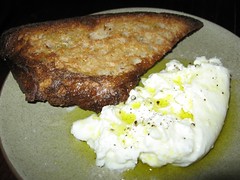
Star Route lettuces, burrata with olive oil and Acme bread toast, pizza with stinging nettles and pecorino

The lettuces were sweet baby leaves lightly tossed with oil, salt and pepper, simple and refreshing although a couple of whole or nearly-whole peppercorns snuck past the garde manger cook and onto our place.

The burrata was actually my favorite course. Maybe it's almost time to revise that oft-used phrase I utter (you know, the I don't like cheese one). Perfect slices of lightly charred Acme levain and a chunk of burrata drizzled with olive oil. The consistency was strange, sort of like the first spoonfulls of cream-topped yogurt, slighlty resistant but then all creaminess. It was great to have the lettuce and the burrata at the same time for the textural and flavor contrast.
this is the burrata. photo by inuyaki.com

Our pizza came streaming hot with a blistering crust. Given that, I would not have expected the center crust to be soggy and slightly wet, which made it impossible to eat out of hand without resulting to all kinds of New Yorker folding strategies. There was something sweet--distracting because I couldn't place it--and there were (unmentioned in the menu listing) slightly crunchy red onions on the pizza. The nettles were wilted nicely and well cooked, except the long stems had ben left on and those were stringy.

I really wanted to like the pizza. I have the feeling if we'd ordered a different (read: nettle-less) pizza, it would have been better (no stringiness). But we were dining with a vegetarian and that was the one that leaped out at all of us. What we ordered was enough food to feed three people comfortably, which was nice. We walked out of there happy and not too full.

We actually didn't get dessert. Fairly full on what we ate. It was clear from the menu items, the menu language, the presentation and the dessert that Pizzaiolo is one of those ex-Chez Panissey places. The servers assemble the desserts themselves, on the restaurant floor side of the line. Drizzle of verbena anglaise, puff square, sauce with apricot compote, dust with 10x. Interestingly, most tables did seem to order dessert and the ice cream was a popular choice.

Monday, June 29, 2009

Bay Area pastry chefs just can't catch a break?

Tough times to be a pastry chef. Not only are patrons tightening their belt (and their budget) when it comes to fine dining and desserts, but this morning Michael Bauer kinda called you boring.

Part of the reason is that my expectations are low writes MB after admitting that he routinely gives restaurants with poor dessert choices 3 stars, giving GMs, head chefs and owners the impression that it doesn't matter who's making their pot de cremes and seasonal fruit galettes.

It's also challenging to review desserts, claims MB, because those darn restaurants could be bothered to send him a menu. Do they even give him the PC's name? From the blog:

When we call for menus each week for restaurants I'm reviewing, we have to specifically ask for a dessert menu, otherwise there's a 50-50 chance we won't get one. Even now we sometimes have to call again, which suggests that many restaurants aren't invested in the sweet course. That's probably the reason I see many unbalanced offerings: too many creamy puddings or too much chocolate, for example. I can't even estimate how many restaurants I've been to that have an ice cream component in every dessert.


This isn't the first time MB's complained about the sweet fare out here.

My suggestions for the Bauer? Well, I'd love to see him champion the desserts we DO have. Imagine if he were using his powers of suggestions to offer up examples of success rather than lambaste the options? Also, it seems like Bauer's talking to chefs about desserts but no one's talking to the diners. Chefs are picky. Chefs want to play with toys. Chefs have been making creme brulee for their entire damned career and probably want something new. True. I support all of that.

But let's flesh out the idea that Bay Area people aren't some bizarro boring-dessert lovers, shall we? I mean, Creme Brulee Cart man seems to be doing pretty well.

And let's take a second to think about the many fine bakeries in this city who do offer something a little more interesting. The continued success of places like Kara's Cupcakes proves that people will go out of their way to pay a little more money for an item that's organic and tasty (though they could use some new flavors!)

Friday, June 26, 2009

sweet life bakery, eugene, or

It was a craving for diner food that made my friend and I pull off the I-5 in Eugene OR. First the iPhone sent us to a creepy town across the river from Eugene, the kind of town that can only be the setting for that old fiction topic The Stranger Comes To Town. Well, we were the strangers and we rode out.

In Eugene we found a newfangled diner and purchased elaborate burger sandwiches and fried goods. Tempted by the sign on the door that read Pie Happy Hour 3:30-5 we asked out server to explain, which is how we found out about the Sweet Life Patisserie, who supplied Happy Hour pies.

thanks gina pina

It would be open till ten or eleven. We would fine a line outside the door, she assured us. And it was not to be missed! So we paid, crossed town to the bakery, and waited in a very long line. Maybe you've never been to Oregon or maybe you are one of those people who only goes to Portland, so it bears explaining here: the majority of rural Oregon has a problem with the gays. Sure, Eugene is a college town, but we'd seen neither hide nor hair of queer culture and a whole lot of fundamentalist bigot radiom and the only gay bar in Eugene had closed down 2-3 years earlier.

Once we made it into the Sweet Life we tried to decide between the gelato, chocolates, cookies, cakes, creme brulee, pies and other items. When bakeries have a lot of items I tend to get nervous, because you can't reasonably expect one chef to excel in all those areas.

I went with the mixed berry pie (blueberry, blackberry, ollalie and marion, which prompted a discussion on Marion Berry...my friend thought it was a joke) and he got the chocolate strawberry cake, basically a chocolate version of strawberry shortcake (whipped cream frosting, ganache, strawberry compote). Coffee drinks to go.

My pie was great. They heated it up for me and gave me a generous slab (for $4, I'd hope so), although they didn't offer whipped cream or anything I guess you could buy ice cream to get it a la mode. The cake was moist, the berries flavorful.

Here's what was so exciting about the Sweet Life: it offered a place for the smart kids, the geeky kids, the gay kids to go and hang out in a town that didn't seem like it had much cultural escape to offer. The cashier at the sweet life was totes gay. And the day before our visit, the Sweet Life bakery had participated in Bites for Rights, a fundraising program that donated 15% of the day's sales to Basic Rights Oregon, an equality organization.

As if being progressive on the issue of equality isn't enough of a reason to love Sweet Life, here's another:

the bakery is super conscientious of those with food allergies and dietary restrictions. Vegans and gluten-free girls, little signs in the case will tell you which products you can eat, so you don't have to hold up the line asking.

Tuesday, June 23, 2009

amazing apricots 1

I remember the first time I ate an apricot. It was my first time in California, I was visiting family in Woodside, and I bought an apricot at the local market because it felt so California to me. And also because I'd never seen a fresh apricot.

I experienced what many people experience when they bite into a fresh apricot. The flesh was mealy, the flavor underwhelming, the skin spongy. I did not eat another fresh apricot for about six years and I gave them another try only grudgingly.

If you've ever thought these apricot things are so mealy and yucky...i contemplate eating them because i really want a fresh peach and the peaches aren't ready, well then, this post is for you. see, apricots deepen in flavor when cooked, and the mushy complaint of their texture turns soft. How, exactly, you say?

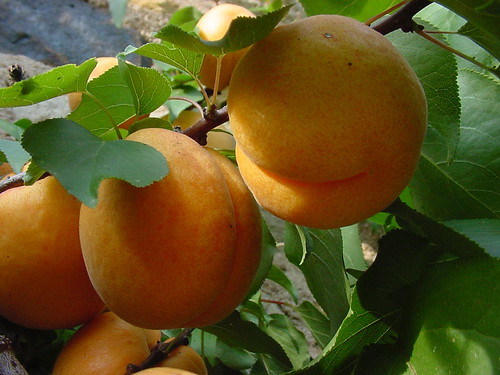
image by max xx

Close your eyes and think of a peach pie. You know how the peaches are bright, how they taste like you think yellow would if yellow had a taste? How they're probably one-dimensionally sweet from all the sugar added in the pie? When you cook apricots like this, don't be surprised if you turn down the next piece of peach pie someone offers you.

Pit and halve a bunch of apricots. Put them in a pot with some sugar and a splash of water. If you have a vanilla bean, you can throw one in. Apricots and vanilla really sing. If you've got a good honey, you can use some honey. What else could you use? Chamomile, dark brown sugar, brandy, lemon. This is not a list of ANDs, however. It's a list of ORs. Any item on this list will complement the apricots, but so that you understand the beauty and complexity of an apricot once it's cooked, choose sugar plus one, or even a rich type of sugar like muscovado or maple or demerara. Something special.

Cook the apricots plus sugar plus water (plus extra) over medium heat. Let's say you have six to eight apricots. I would add 1/3 to 1/2 cup sugar. You can always add more sugar but you can't take it out. The fruit will start to break down and release its juices. Continue cooking until the juices thicken. I'm not going to give you a more exact recipe than that, but I will answer questions. You will be left with a delicious compote that I like to serve warmed over vanilla ice cream.

Learning how to cook apricots will change your life. If you're lactose intolerant, spoon them over soy yogurt with granola for breakfast, and if you hate sweets grab a nice cheese and good bread because this compote is versatile, easy, cheap and delicious. Promise. If you get inspired to try this and make a new, fun combo, let me know.

stuff that's keeping me happy lately

I've been so busy traveling. There's a lot that I want to tell you about but it's going to take a while. In the meantime here's a teaser of stuff that I've been into lately:

  • pilot books, seattle
  • amazing apricots
  • breaking news: harvard lays off 275 employees --> THIS IS NOT SOMETHING I LIKE
  • molly moon's, seattle
  • finding a gay friendly bakery in eugene or
  • inner sunset farmers market, sf
  • modesto jr. college egg farmers
  • being so close to the end of chapter 3, phew!


photo by James Callahan

Sunday, June 14, 2009

Andre Dubis-isms

While searching my hotmail inbox for a recipe for rosemary-soy chicken wings, I unearthed an email from a grad school professor that contained a list of anecdotes about the esteemed writer Andre Dubus Sr.

Known among writers as "Andre Dubus the father," so as to distinguish the subject from his son, the Andre Dubus who authored The House of Sand and Fog, the elder Andre Dubus is known primarily for his rich and haunting short stories. Dubus is one of those people described frequently as a "writer's writer."

What does this mean? Certainly it ranks up there with the haughty-yet-cliched terms bandied about by teachers and students of writing in MFA classes and advanced-level college workshops. Both curse and blessing, being a writer's writer is like being crowned prom king AND valedictorian. Your writing is layered, rich, resonant (oh, cliche!), your endings are earned, your characters' dialogue is never petty nor trite.

Joking aside, what this means primarily is that you are someone aspiring writers need to have in their toolbox. You have something to teach writers--how to tell a good story--as well as readers. If you are a writer's writer, you might not be well-known by the general reading public.* You might not have a bestseller, or financial success. You are a rocks glass of smoky scotch beside a fireplace while soft snow settles onto the eaves of an old house. You are special.

Another of my professors was an old family friend of Andre D's, and had the pleasure of sitting through many a Red Sox game with the old man. He used to tell us stories of Andre's adoration for the gummy New England accent, and the hardworking-hard-drinking working class baseball fans you can encounter at Fenway.

While his Andre stories were more character-driven, the list of Dubus-ism I found portray not the man himself, but the quirks of a writer and the instructions in a practice.

  • Andre Dubus (father) wrote 100 pages to "find" the seven pages of his story "Waiting." It took him fourteen months.
  • Andre Dubus always recorded how many words he wrote each day. And everytime he said "thank you." -- "28 words, thank you." OR "1200 words, thank you."
  • Andre D was at a party once where there was a fistfight over whether something falls to "earth" or to "the ground." Carver was for "ground."
  • Rick Russo said of Andre D's prose style "Once you are a Catholic you will be using that language the rest of your life, even if you don't believe in the dogma anymore."
  • Russo said that reading Andre Dubus and Richard Yates when he was in an MFA program at the Univ. of Arizona saved him--because at the time everyone was reading Gass, Coover, Hawkes, Vonnegut, etc.
  • Rick Russo quoting a friend: "Just becasue it didn't happen doesn't mean I can't remember it."

*Dubus the father's short story Killings was adapted into the movie "In the Bedroom."

Friday, June 12, 2009

the three strikes bakery rule

When trying out a new bakery, I almost always follow the three strikes rule: no matter how I feel about something on the first visit, I'm not allowed to rule it out until I've made two more visits. There are so many variables that could affect the initial impression, ranging from my mood or the weather to an overly salty batch of dough the kitchen made or a slightly stale cookie.* I might visit with a friend and try a few items; in that case, I'll relax the rule a bit.

Last night in the Castro, I told my friend something vaguely upsetting as we were walking back from dinner. Surprising, no. Upsetting, yes. He clutched my arm and, rather than respond to what I'd been saying, demanded cake at that very moment. Let's Go Into Cafe Flore, he said, pointing at the Castro landmark.

image from aweigend.

I've been to Cafe Flore many times, and quite enjoy it for a lingering coffee with friends on a rare sunny-AND-warm San Francisco day, or for late-morning brunches. The eggs are always good, and I respect a tiny postage-stamp of a kitchen that can stay on top of their game. Over the years I've had a couple of their desserts and been lukewarm, most notably for the chocolate violet souffle cake that tastes nothing like violets. Chocolate cake does not need violets, no, not at all. So if you are going to create a violet-chocolate cake, please make sure it actually tastes like something? ok?

We skipped the cheesecake, considered the chocolate cake, and decided to share a slice of the banana foster pie.

What looked like a simple custardy confection ended up being a four-layer pie that, if slightly too sweet, was rich and creamy and perfect for sharing. Deep cookie-crumb crust got a layer of caramel, and another one of rum-vanilla custard. The pie finished with a banana cream and a caramel drizzle. The pie was one of those occasions something tastes better than it looks, the flavors rising above the ho-hum prissy bakery presentation that we all groan over. Lucky for Cafe Flore, this was my third visit.

I'm often considered a snob about food and other things, and I am, sure. That said, there's a place for the ok, the humble, the merely good. The pie was as good as some items I've had from places like Tartine and Citizen Cake. Sometimes we don't want to think that way. It helps, when paying Tartine prices, to believe you are getting the absolute best there can be. There are days when all you want is a sweet and uncomplicated piece of pie, a little sunshine, an outdoor table, and a dose of queers.


*Note to cooks and kitchenworkers: it's actually really important to taste everything you sell every day (sauces and such, maybe every 2 days, unless they're fruit-based). I've seen anglaise go bad in the squeeze bottle during a service. I've also worked at restaurants that serve, day in and out, horribly stale versions of Claudia Fleming's brownie cookies, which is not only gross but completely disrespectful.

Thursday, May 28, 2009

heading out of town

see you in a while, cali! it's cold and foggy here and i'm in need of some time to relax. i've got a new stack of library books. i'll pack my prepster shorts, charge the ipod and fly out tonight.

see you soon, herrell's, jp licks, hi rise, sofra? doughnut plant, i'll catch you on my travels too, and il lab, and maybe momofuku?

Sunday, May 24, 2009

what we talk about when we talk about food

Lately I've been thinking that I wouldn't have this blog if I were starting it today. Right now the market seems saturated for this sort of thing, and while that wasn't any less true (probably) three years ago, I had fresher eyes for the genre back then.

When Francis Lam wrote about his quest to make a perfect omelet, he's writing about the sense and muscle memories, and the intuition that make a good cook. When Michael Ruhlman wrote about driving down Route 9 in a blizzard for his culinary exams, it certainly wasn't the test that was on his mind, but the necessary sacrifices of time and will that you are required to make if you play the game. He understood it was a test of character. When Molly O'Neill wrote about learning to butcher and cook fish in a Provincetown kitchen, she was really talking about grit and integrity, about the differences in a kitchen between insider and outsider, and how we permeate those boundaries. As well as the need for the flavor of the fish to dictate the cooking method, and the importance of seasonal and local ingredients back before our country really had a culinary movement. Carol Blymire's posts at Alinea at Home are about the fear of failure and the comfort and courage that food offers us, as much as they are about xantham gum or agar. And when Ruth Reichl portrays Wolfgang Puck and Alice Waters in the early days of California cooking, it isn't the food, though it's evocatively described, so much as the passion and vision of these young cooks before they were culinary figureheads.

What we talk about when we talk about food isn't food. This is a balancing act that is difficult to execute consistently. Oh, it's tempting to get caught up in describing the flavor of a rare ingredient or fresh heirloom produce gently coddled in the hands of some culinary idol. It's exciting to talk about the atmosphere of anticipation that surrounds the diners-slash-audience embarking upon a tasting menu. It's easy to write about food--and to write something interesting--only on the level of the food itself. But it's not satisfying. And it's not transcendent.

It's good to remind myself of these things, because I've been struggling to write about food, and I've been slightly checked out of the food debate, catching only faint whispers of SF rumors and trends, rumbles about Bruni's replacement and so on. In my own writing I've been stalling, researching, and committing that crime of writing about food only on the surface.

I've become so tired of the way we talk about food, either in the present media moment of here in SF. Recently Robert Beringela (pseudonym) serialized a "food noir" tale in San Francisco magazine that, while at first glance amusing and pointedly thumbing its nose at this tiny-city-of-food-cliche, eventually revealed itself to contain no more substance than the ubiquitous beet/goat cheese/mixed green salad that's grown so offensive round here.

I've had the dubious fortune to be at two restaurants during opening review process, so experienced the MB hype, stressful service, and inflated prose {for the record, when a critic's in house, we most often know it, at least by dessert!}, plus the anticipation of waiting for review. But parsing the sentences of a Bauer review isn't wholly satisfying, in parts because MB can play favorites with his chefs, and to a lesser extent with styles and trends.

More than ever it's important to support the places where real, honest conversations about food are taking place. I'm talking about your local farm markets and your organic bakeries, and Gourmet and Saveur, but not the other food magazines, your specialty stores and restaurants, and your own kitchen, your own cooking. Make it count for something.

The food scenes in my writing are actually the more difficult ones to write, because while my writing brain wants to put something down and go ahead, the cook in me begins to parse the dish. Is it good enough? What cooking techniques are necessary? What's the mise look like, and whose station's it coming off of, what's the fire time? Why would the chef choose these things? What am I really trying to say?

Wednesday, May 20, 2009

vanilla bread pudding with stone fruit

I used to be a little snot (used to be, you say?). One day during the course of my stage at Oleana, I told the pastry chef, Maura, that I wasn't a fan of bread pudding. I hadn't yet learned that you don't tell this to cooks; that claiming not to like something ends with you being prodded or strong-armed into trying their adaptation of it. Sometimes, when we say "don't like," what we mean is don't understand or aren't impressed by or, as my french chef used to say, "it is not very interesting."

I worked at the time at a bistro in Boston that served chocolate bread pudding with whipped cream (side note: it really irks me when people call it chantilly on menus...it's whipped cream people). We made four hotel pans of the stuff, using leftover house bread (baked by me & my boss) plus the supplementary bread we got on the weekends. The night guys usually cut the bread for us, two large fishtubs, but occasionally we'd have to top it off, then make the custard. I'd be up to my elbows in the stuff, tossing the bread, letting it soak. Then I'd have to portion it into the four hotel pans, bake them in barely-there hot water baths consisting of the 1/2-1 inch of water I could pour on the full sheet pan and, when baked, pull these same suckers out of the oven without spalashing hot water all over myself and burning the mitts. So I was usually pretty clumsy and usually made a mess (big surprise, right?). Suffice to say I'd had it with bread pudding and I felt that I was pretty well informed on the topic.

Well it only took a couple bites of Maura's bread pudding to change my mind. Hers was made with homemade brioche, pretty standard, and I had excellent results baking it with Acme pain de mie as well. Maura soaked her bread in a mixture of custard plus simple syrup; her theory was that the simple syrup prevented the bread from getting too heavy and resulted in a lighter final product. I'm not sure whether that's true but I know the results are certainly delicious.

This version below features stone fruits, with cherries just coming into season! We don't have peaches yet but we do have apricots, which are delicious baked or roasted. As promised a long time ago, here is the bread pudding recipe adapted from Maura's supremely wonderful brown butter bread pudding with mulberries and milk jam at Oleana.

vanilla bread pudding with stone fruit:
{makes 1 lg. deep dish pan (9x13) +/- a few extra ramekins}


custard base:
eggs 9
sugar 2.5c
cream 4c
milk 2.5c
vanilla bean 2, split and seeded

for soaking:
simple syrup: 1c
cubed bread: 8c
custard base above

fruit, to add:
pitted cherries: 2c
peeled, sliced peaches: 2c

Warm dairy with vanilla beans and infuse 30 minutes. Whisk eggs and sugar together. Add cream and milk. Place bread in large bowl, coat with simple syrup and then with custard base. Let soak 1 hr or until most of liquid is absorbed, tossing bread every so often. Add cut fruit to soaked bread and mix. Pour into baking pan, using ramekins for any overflow. Cover with foil and bake at 325 for 35 minutes. Remove foil and bake 15 more minutes or until top is lightly browned. Center should be set. If not, keep baking.*

*I worked somewhere where we baked bread pudding FOR THREE HOURS once.

in other notes:
*huge burn blister on my finger with goo bubble the diameter of a caper. it needs to go away.
*valrhona cocoa powder, how i have missed you.
*i should do a post on ways to infuse vanilla beans, maybe i will.
*i ate the second half of my burrito for dinner and now i have nothing to look forward to at work tomorrow.
*claudia fleming is still awesome.
*i've been reading a book a day, about.
*my car is not dead and gone forever. hell yeah! road trip seattle anyone?
*i'm contemplating a series of podcast essays. main problem: i'm not interested in the sound of my own voice, unless i'm pretending to be claudia gonson. second main problem: that just sounds gimmicky and slightly pretentious.
*i need to learn to say no, sometimes, and stop doing everyone a favor all the time.
*i chopped orange peel for a long time today and it was really theraputic and zenlike. i recommend it.

Monday, May 11, 2009

flaky lemon shortbread

Shortbread is a taken-for-granted kind of cookie. It's usually ho-hum, buttery, sweet, nothing too special. It's versatile. You can add spices, citrus zest, vanilla bean, cocoa nibs. Some people really enjoy buttery, flaky cookies and my mother is one of them, so this is what she got for Mother's day. For the record, it shipped well and did not break. Always useful information.

This particular shortbread is flaky, tall, and soft. (There are other chewy shortbreads that are delicious too and this is not one of them). It's adapted from the Tartine cookbook. I've tried it out a couple of times and it's critical to do it by hand, with the butter at a supersoft consistency. As if you've left it out on a humid July day while you went to the corner store for some eggs, ran into your neighbor, chatted for fifteen minutes, and came back home to find squeezable, malleable butter.

If you'd rather make this shortbread, orange, vanilla, (orange-vanilla), fennel, baharat, or anything else, you go right ahead. How do you do this? Add some flavoring (seeds from 1 van. bean, 1 t spices, etc), and then taste the dough. Start small...for obvious reasons.

Lemony shortbread:
(makes one 9-inch round, to be cut into 8-10 wedges)

soft butter: 9 oz.
salt: 1/2 tsp. + pinch (reserved)
lemon zest: 1-2 large lemons*
rice flour: 1/2 c. + 2T**
granulated sugar: 1/3 c. + more for topping

Paddle softened butter with a spatula by hand until creamy. Work in sugar and lemon zest. Add rice flour and mix until dough comes together. Pat dough into baking tin and smooth to level grade. Top dough with granulated sugar and reserved pinch of salt. Bake in 325 degree oven 30-40 minutes. Should be just slightly golden but cooked through in center. Let cool before cutting.

*I used Eureka lemons.
**Cornstach can be substituted for rice flour.

Thursday, May 07, 2009

so sorry

About two years ago, I received a comment on a short story I wrote that was published online. Apparently.

I just noticed this comment tonight.

Someone named Tricia begged me for the recipe for the brown butter bread pudding with milk jam from Oleana, the beloved Cambridge restaurant. How Tricia knew I'd spent time in the Oleana kitchen is a mystery...maybe she read the story, googled me, found the blog? Or the other way around?

Anyway, Tricia--who I'm sure will never read these words, not unless she's still out there googling toward Oleana's decadent yet homey brown butter bread pudding, I'm sorry. I do have that recipe tucked in a tiny pink notebook. I used to make that bread puding at Frog Hollow all the time, a brown butter version with pears and dried fruit, and a vanilla custard version with stone fruit. It was pretty universally loved.

I've got the recipe for milk jam also, a Middle Eastern confection similar to dulce de leche, made on an all-day slow simmering stove. I haven't made milk jam since those days, but I know that I will one day.

Three weeks and counting til I get to go to Sofra myself and maybe, if I'm very lucky, they'll have a version of that bread pudding for sale. In the meantime, two years too late, sorry.

Tuesday, May 05, 2009

thought stream of revision

{or, some of the junk that goes through my mind}

One of the things I try to do each time I'm working on revisions is give myself the time to re-read the current draft before diving in, especially if it's been a while. It's always great to have writing work that *feels* like writing, but the main reason for this is so that I can spend some time (re)remembering what I wanted to write about in the first place. Usually I'll try to get all the way through without listening to the editor in my head, but when I do let the editor's voice shine, it tends to go something like this:

1. weak beginning...OMG, takes two pages to get to the meat of the story! no bueno!
2. do we have a pretty good sense of who the protagonist is and what he wants by page 2, at the latest? why not?
3. what is the particular problem in this story? is that clear to readers? {usually, in an early draft, the answer is NO}
4. is the landscape clear? {not only the physical landscape/geography, but the other characters that help my MC define himself}
5. insert time-honored/exhausted workshop tropes. pick your favorite, which may include what's at stake? there's not enough tension in this piece. the dialogue/characters is/are flat. and you haven't earned the ending.
6. remember the things that are your weakness. for me, it's an overuse of exposition. which sucks, because I like a lot of exposition, and I'm willing to put up with a lot of it if the writing is good. however, exposition for its own sake is no longer popular in today's literary fiction...and who am I, just another writer, right? right.
7. remember that you are standing in your own way: that your pride, or your adoration for minor character #7 (the one with the harelip and the broken umbrella), or your determination that you know exactly what the piece is about, or your brilliant wit in paragraphs 3-5...if you are going to have a finished, polished piece, most of the things you love will die or mutate.
8. get real quiet and listen.


last night i learned that i totally forgot to convert one page from first to third person, so, sorry brooke, don't be confused when you read the excerpt i sent you. i learned that there's not as much exposition (yes!) as i remembered and nearly no backstory (double yes!), that my characters are still sickly thin, that the madcap caper tone of the chapter isn't being read through the agonizing level of detail i invested trying to make the plot believable, and that what will make the plot more believable is rounded characters stuck in a conflict.

who, what, where, when, why? and why now? i try to be kind on a first raft. i don't have high expectations. and when i'm going through this process, i'm certainly not doing it with a little checklist beside me. to date i've spent, oh, 6-8 years workshopping pieces? i know how to ask these questions, whether it's about your piece or mine. to know what to change, you need to make a series of quick, frequently subconscious decisions. it's wrong because it is. the dialogue reads awkwardly, and when you say it aloud you'll hear. we know when something doesn't sound right because most of us have been reading for what feels like forever.

that, when you think about it, is pretty significant. what else have we been doing all our conscious lives, other than eating, sleeping, losing our tempers, and discovering things to love and find beautiful? ok, and watching television. play kitchens turned into real ones, stuffed animals became pets, and the other games of childhood fell away unless we play them with our children or other people's. i'll stop now before this gets too fever pitch {the movie, not the novel...i actually can't stand nick hornby. sox win, btw!} but consider the implications...what sort of people still care about the same things they did when they were 7?